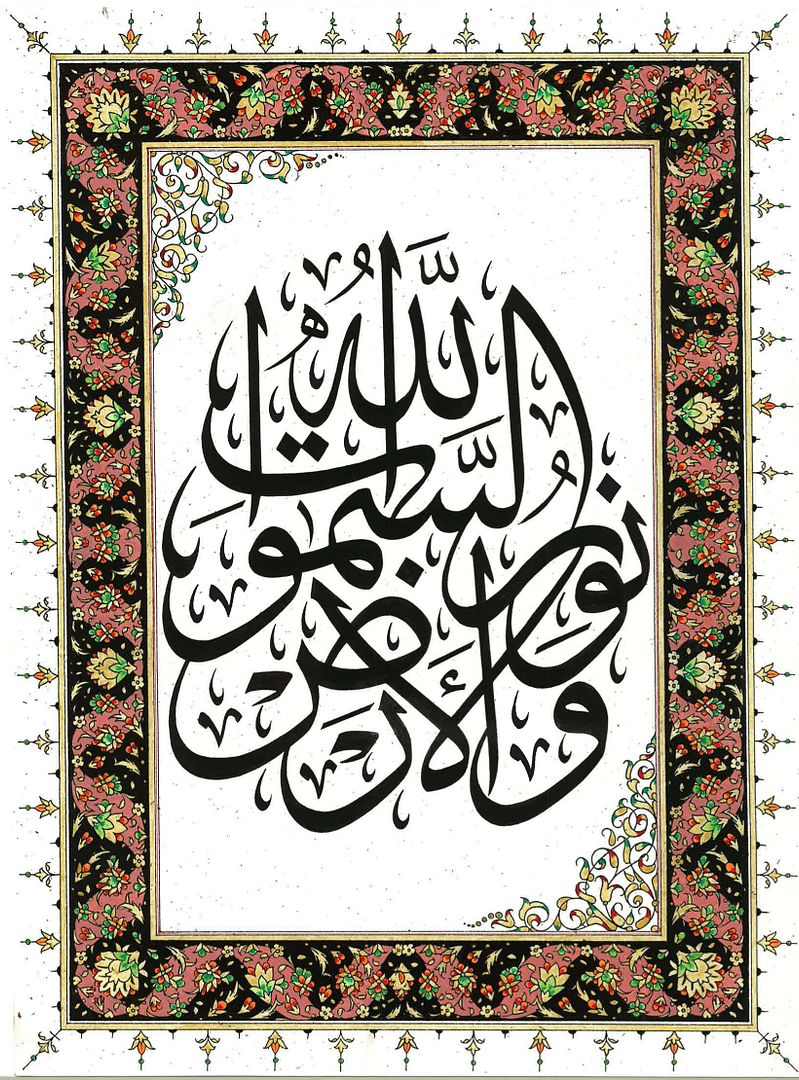
The fall of my choice to the Prophet Muhammad in the first list of Hundred People with influence in the world while it may surprise the reader and may be some other question marks. But I stick to my belief, he was the Prophet Muhammad was the only man in history to successfully achieve remarkable successes both judging from the size and scope of secular religion.
Originating from a simple family, the prophet Muhammad uphold and propagate one of the world's largest religion, Islam. And at the same time appearing as a tough leader, pure, and effective. Now, thirteen centuries after his death, his influence is still strong and deep and rooted.
Most of the people listed
in this book is a lucky creature was born and raised in centers of civilization, cultural and extra high political circles nations. Prophet Muhammad was born in 570 AD, in the city of Mecca, in the little southern Arabian Peninsula, a place that time was the most backward regions in the world, far from the center of commerce, arts and science. Being an orphan at the age of six years old, grew up in a situation about a simple and humble. Islamic sources mention that Muhamnmad illiterate. The situation began to improve in the new economic age of twenty-five years old when he married a widow was. However, until near the age of forty barely visible hint keluarbiasaannya as humans.
Generally, the Arabs when it did not embrace a particular religion but a pagan Mecca in the town there are a small number of followers-followers of Judaism and Christianity, and the possibility of Muhammad for the first time they heard about the existence of the Almighty God, who set up all over the world. When he was forty years old, Muhammad convinced that God Almighty is to say something to him and chosen him to be a correct belief spreader.
During the three years of the Prophet Muhammad spread religion only limited to close friends and relatives. 613 when entering the new year he began to appear in public. Once she gradually got followers, ruler of Mecca saw him as a dangerous man, maker troublemaker. In 622, worried about his safety, Muhammad fled to Medina, a city in the north of Mecca is 200 miles. In the city he was offered a position of political power is quite convincing.
Events move is an important turning point for the life of the Prophet Muhammad. In Mecca he was difficult to obtain a small number of followers, and followers of Medina growing at a brisk pace so that he could gain influence which makes it a real power holder. In subsequent years while the followers of the Prophet Muhammad emerge like mushrooms, a spate of fighting broke out between Mektah and Medina. The war ended in 630 with a victory on the part of the Prophet Muhammad, returned to Mecca as conquerors. The remaining two and a half years of his life he witnessed tremendous progress in terms of rapid Arab tribes embraced Islam. And when the Prophet Muhammad died in 632, he was sure he was as effective ruler across the southern part of the Arabian Peninsula.
Bedewi tribe has a tradition passed down through generations as formidable warriors and brave. However, their number is not a lot and always tempted divisions and confront each other with each other. That's why they can not outperform the army of the kingdoms established on a farm in the northern hemisphere. But Muhammad first person in history, thanks to a strong boost confidence in the oneness of God, the tiny Arab forces capable of an astonishing series of conquests in human history. In the Arab standing next to northeastern New Persian Empire of the Sassanids wide. In northwestern Arabia stood Byzantine or Eastern Roman Empire with Constantinople as its center.
Judging from the number and size of the angle, obviously would not be able to deal with Arabs. However, on the battlefield, the Arab forces were burning zeal with lightning strokes to conquer Mesopotamia, Syrian, and Palestinian. In 642 Egypt was taken from the grip of the Byzantine Empire and the Persian army while it was beaten in a very decisive battle in Qadisiya Nehavend in 637 and 642 AD.
However, large-scale conquest-under the leadership of the Prophet's companions and his successor Abu Bakr and Umar ibn al-Khattab-did not show signs stop stop there. In 711, the Arabs of North Africa have been swept away to the edge of the Atlantic Ocean. From there they turned north and crossed the Strait of Gibraltar and berated the Visigothic kingdom in Spain.
At first glance one should think the Muslims will lick up all of Christian Europe. But in the year 732, in a famous and terrible battle at Tours, the Muslim army had advanced into the center of the French country eventually beaten by the Franks. Even so, only within secuwil century battle, these people Bedewi-imbued with the sayings of Prophet Muhammad-had established an empire stretching from the Indian border to the white sands of the Atlantic Ocean beachfront, the greatest empire ever known to human history. And where was the conquest by the Muslims, it is always followed by in large bondongnya entered Islamic adherents.
Apparently, not all conquest is permanent. The Persians, though still loyal followers of Islam, regained its independence from the hands of Arabs. And in Spain, after over seven centuries of warfare finally recaptured by the Christians. Meanwhile, Mesopotamia and Egypt, the birthplace of two ancient cultures, remains in the hands of Arab as well as across the northern coast of Africa. Islam, of course, continued to spread from one century to another century, stepping away from the conquered. Generally scattered millions of adherents of Islam in Africa, Central Asia, especially Pakistan and north India and Indonesia. In Indonesia, the new religion of Islam was a unifying factor. In the Indian subcontinent, almost the opposite: the new religion was the main cause of the break up.
Is Prophet Muhammad influence the most basic to human history? As with other religions, Islam has an enormous influence on its adherents. That is why the spreader-spreader major religions of the world can all place in this book. If measured by the number, the number of adherents of Christianity twice the size of the adherents of Islam, in itself raised a question mark what is the reason to put the order the Prophet Muhammad higher than Jesus in the list. There are two principal reasons that so my grip. First, Muhammad played a far more important role in the development of Islam than Jesus role of the Christian Religion. Although Jesus was responsible for the basic teachings of the Christian morals and ethics (to a certain extent different from Judaism), St.. Paul is the main character of Christian theology spreaders, penyebarnya figure, and author of the greater part of the Old Testament.
Instead the Prophet Muhammad is not only responsible for the theology of Islam but it also points to the ethical and moral. In addition he was "recording" of Scripture Al-Quran, a collection of revelations to the Prophet Muhammad which he believed came directly from God. The vast majority of this revelation earnestly copied during Prophet Muhammad's time, and then collected in the form of unfailing shortly after he died. Al-Quran is thus closely related to the views of Muhammad and his teachings because he relied on God's revelation. In contrast, none of which are so detailed collection of the teachings of Jesus that can still be found in the present. Since the Al-Quran for Muslims somewhat as important as the gospel for the Christians, the influence of the Prophet Muhammad through the medium of the Koran teramatlah magnitude. Possible influence of the Prophet Muhammad in Islam is greater than the influence of Jesus and St. Paul in the Christian world combined. Measured in purely religious angle, it seems the effect is equivalent to the Prophet Muhammad Isa in the history of humanity.
Furthermore (unlike Jesus) Prophet Muhammad is not only religious leaders but also the leaders of the world. The fact is, as the driving force of the movement of the Arab conquest, the influence of political leadership was in the forefront at all times.
Of various historical events, one might say it could happen without the leadership of someone special before them. For example, colonies of South America might be able to free themselves from Spanish colonialism although Simon Bolivar had never existed in the world. However, this example does not apply to the movement of the Arab conquest. There is no similar incidents before Muhammad, and there is no reason to deny that the conquest could happen and be successful without the Prophet Muhammad. The only similarity in terms of conquests in human history in the 13th century the most basic part thanks to the influence of Genghis Khan. Conquest, although wider scope than what the Arabs, it is not able to prove stability, and now the only areas occupied by the Mongols was the same as before the time of Genghis Khan
This clearly shows a large difference to the conquest by the Arabs. Extending from Iraq to Morocco, stretching chain united Arab nation, not only to the Islamic belief but also from the Department of Arabic, history and culture. The central position of Al-Quran among the Muslims and written in Arabic, the likely reason why Arabic is not divided into dialects that berantarakan. If not, may already be happening l3 century. The difference and division into several Arab countries would take place, of course, and in fact did so, but the divisions that are in parts that do not necessarily make us negligent that their union is still tangible. But neither Iran nor Indonesia are both populous Muslim country and second oil producer, did not join in the attitude of the oil embargo in the winter of 1973 to 1974. Instead of goods is not coincidence that all Arab countries, exclusively Arab country, who take the oil embargo.
So, we may see, the Arab conquest in the 7th century continue to play an important role in human history to date. In terms of that I judge a incomparable combination between their religion and worldly aspects inherent in the influence so I consider myself Muhammad the Prophet Muhammad in a personal sense is the most influential people in human history.

allahuakbar
ReplyDelete